
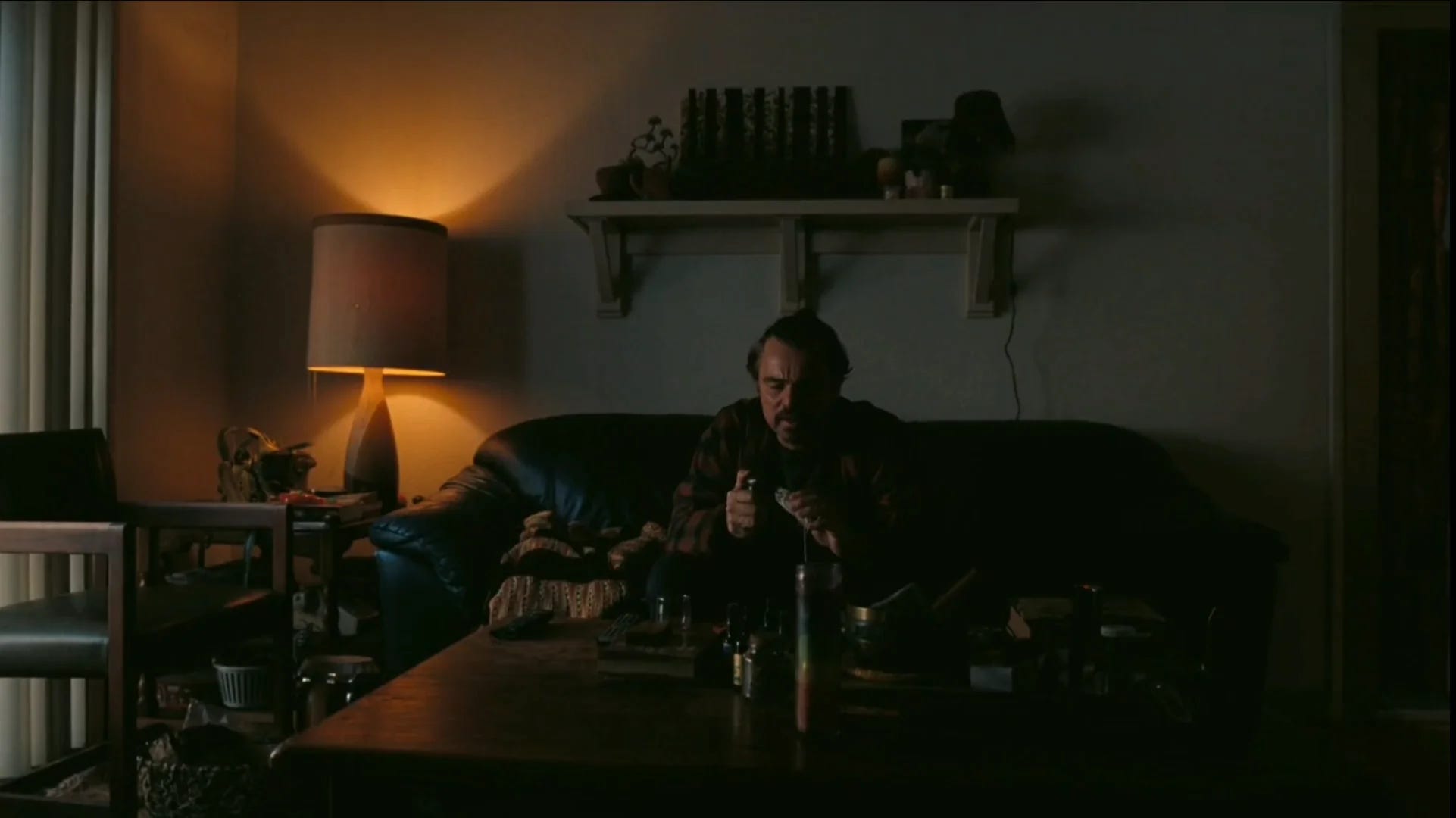
My first thought was: One Battle After Another is one of the most reactionary movies I’ve seen in a while. The driving premise appears to be that revolutionary fervor is at root a working out of psycho-sexual obsessions, and where it’s not that, it’s delusional, and where it’s not that, it’s impotent. A sort of Nobility of Losers, an inverse Lost Cause-ism.
In this, it rings a bell to anyone familiar with Latin American revolutionary movements, as I once had some cause to become. It would seem that much of the mainstream American “safe revolutionary” (à la “safe horny”) ethos has been laundered, consciously or not, through originally Latin American mythologies of resistance. These are close at hand enough to feel accessible, near in time enough to feel politically relevant in a way our own revolutionary origins no longer do, and yet foreign enough to feel both thrilling and not quite real.
***
Some of the persistent dynamics of the revolutionary ethos:
—the glorification of violence qua violence as a purifying, uniting, and transforming force (Che, Fanon);
—the intermingled sense of both inevitability (El pueblo unido / Jamás será vencido) and the romance of impossibility;
—the tension between chauvinistic nationalism and international solidarity (Neruda is good for seeing how creatively a mind can thread this schizophrenic needle, precisely because he is a great poet);
—the tension between desperation to control the state and the fantasy of dissolving it (Orwell’s Homage to Catalonia frames these contradictions tragi-comically for a preceding generation);
—the collapse of maximalist goals of social and even spiritual transformation (again Che, who reads very clearly as a displaced monastic) down into merely liberal procedural goals (e.g. the return of free elections, the acceptance of a market economy leavened with various social welfare policies);
—or, in the cases in which the Revolution has triumphed, the mere recreation of the original corrupt oligarchy reflected back through a sort of fun-house Bolivarian mirror (Cuba, Venezuela, Nicaragua).
***
Perhaps most notably for our cinematic purposes, the rhetoric and motivating fantasies of maximalist transformation do not recede as the original revolutionary goals are progressively abandoned; if anything they seem to become more lurid, more insisted upon, more tinged by the strain of magical realism in which they were birthed.
It wasn’t until 2004, and serious dreams of Maoist rebellion had safely faded, that we were able to get a film of the Motorcycle Diaries, and until 2008 to get Soderbergh’s Che. Both are hagiographies, but, unsurprisingly, the first is much better art: a dreamlike and elegiac bildungsroman, it situates a young man’s “political awakening” within the deeper soil of a life: heartbreak, restlessness, lust, familial rebellion, internal combustion engine-related annoyances, encounters with foreboding and sublime landscapes, and a sincere empathy with the suffering and the oppressed that, like all sincere empathy, is full of sincere anguish and sincere confusion.
It takes a bit more legwork to do the reverse, and fully subsume the messy human into the smooth bore of an idealized political project; though, to be fair, that was Che’s own personal project, which is what made his character all at once tragic, epic, and grotesque.
***
These temptations—toward constant ideological mobilization, toward the total recruitment of the human for some utopian struggle, toward the inevitable slaughters and, of course, the bad art and bad love that result—have, shall we say, not totally dissipated in the years since Che, or Orwell, or Miłosz’s Captive Mind, or the Shining Path. Nor are they necessarily “leftist,” (in scare quotes since it is a word whose last vestiges of fixed meaning seem to have become deeply confused) though “leftism” is susceptible for a variety of reasons. One of which being what Dr. Percy would call its weakness for becoming “abstracted.” That is, the temptation to take refuge from the cussedness of the particular, with all its jagged edges and irreducible desires, in the soothing and antiseptic completeness of “theory” and “systems” and “dialectics” and so on.
One of the interesting tensions is that leftism is in this way highly “spiritual”: seeking liberation from the oppressive restraints of mere matter, of inherited realities and duties, of the dead hand of the past, etc. Walker Percy indeed recognized this error, what he called “angelism,” as one of the siren songs of the spiritual life, though few of either leftism’s adherents or its detractors grapple with the full implications of it.1
That is one reason abstraction is so powerful, after all. It is a means of imposing immaterial Intelligence upon what it sees as the deaf and dumb substrate of the world. The Spreadsheet reins because the Spreadsheet gets results. It can pull hydrocarbons from under the sea and turn them into an infinite calorie glitch; it can launch flesh and blood in the direction of the Moon (which is not that complicated) and return it alive (which is insane); it can convince hundreds of millions of people of pretty much anything; it can rule empires without batting an eye; it can do pretty much everything, in fact, except the important thing, which is to reconcile the individual with her mortal existence, and with God, and with love.
***
Certainly “rightism” (a concept with even less of a fixed meaning than “leftism” since, if it means anything, means “the grab-bag of stuff that sets itself against leftism”) can also give itself over to this sort of permanent politicization of life, and the same sort of brutal arrogance which recognizes no limits of decency, no spheres of life over which it has no rightful claim.
Though the reactionary or counter-revolutionary tendency does have some inborn inoculants to abstraction—mainly, its own incoherence, and, if only sometimes, the knowledge of its own incoherence.
Incoherence is a very human mercy, precisely because, like love, it does not “scale.”
And because a recognition of one’s own incoherence is the beginning, at least potentially, of a real and saving humility. I can’t fix the world; I can’t even fix myself. I can barely figure out how to properly love a single other human being. Maybe one more well-placed block of C-4 isn’t what’s going to help me raise my daughter well, after all.
***
In any case, the particular cussedness of my OBAA theater experience was notably interrupted by the family sitting in front of me, with young-ish teenagers, getting up and walking out after the first half hour was almost entirely an immersion in strange racial-fetish related plotlines.
I hadn’t seen a real walkout in a while; honestly I didn’t blame them. Though I myself am not a walker-outer, am if anything too committed to an artistic experience once it has been entered into, I found myself finding it refreshing: for somebody to care enough about the quality of their remaining fleeting hours on this earth to really reject something.
***
I also didn’t blame them because, visually and structurally, the film is boring, dragging. Though part of the problem is that it’s hard to put your finger on why; scenes of guerilla warfare in American cities should at least provide enough frisson to fill a couple hours. I haven’t read the Pynchon, but I’d be loath to blame him either way. I think novelists take enough shit in this day and age.
In this sense OBAA compares poorly with 2024’s Civil War, which, while also tedious, did capture in flashes the dread of neighbor turned against neighbor, of sunny abandoned highways, of life under unpredictable checkpoints. Above all, it managed to capture the absurdity and randomness of death, coming as little more than the whim of bored youth on the one hand, and the machinations of delusional mandarins on the other: achieving nothing, meaning nothing.
That sort of nihilistic “war is only hell and spectacle” message is part of what makes Civil War tedious; war is many things, and part of the problem of war is that it both draws on and calls out of its participants many virtues, and so even if it is absurd it is not meaningless. Nonetheless, instilling authentic dread (on purpose) remains a notable aesthetic achievement in this decade.
Because OBAA doesn’t ever quite achieve dread, or absurdity, or hope, or even a bracing nihilism. It does achieve, in its first movement at least, some of the horror and squalidness of mental illness, broken families, and the futures of children sacrificed on various altars of ideology; whether it intends this pathos is not clear.
***
I believe that OBAA’s final scene, of Bob’s daughter Willa going off to a vague “protest in Oakland,” was meant to indicate the slow-burning staying power of La Revolución, its inevitability and its ongoing renewal, thus ending on what the protagonists, and the audience, are to see as a hopeful note.
The effect is much the opposite: What it perhaps unintentionally presents us with is the banalification of revolution and the emergence of the Protestor, as opposed to the Guerrilla. The film opens with Guerrillas, a real army with real tactics and a real vision (however deluded) for replacing the political order of the nation; by the end, Dad is lounging peacefully on the couch, apparently now free from any concern over state retaliation, while Daughter heads out to protest as blithely as if she’s headed to a concert.
The Protestor has become institutionalized into a semi-permanent theatrical fixture within the system, rather than a transgressive eruption from outside of it.
El Che would see this for what it is, and despise it. But perhaps he would only see part of it. Perhaps he would not be able to look directly at the part of it his ceaseless self-mythologization contributed to.
***
As with many paranoic fantasies, narratives of revolutionary grievance inevitably subvert themselves by portraying the Enemy as simultaneously wretched and all-powerful.
This dynamic is seen perhaps most clearly in anti-Semitic tropes (“What are you so happy about?” “This newspaper says we rule the world!”), but in OBAA the role of the shadowy cabal is played by some melange of the rich white suburban Republican archetype. The important point is not who exactly they are meant to represent, but that the Enemy is portrayed as invincible, almost mythologically impenetrable. That Sean Penn’s character is presented as a pathetic interloper whose pretensions to the Inner Ring are easily batted aside only highlights the cabal’s insuperable evil competence.
That invincibility is important, structurally, because it is a necessary premise if the revolution is to be permanent. And it must be permanent. It may asymptotically approach Victory but, like Sisyphus, can never truly grasp it, even when it wins. Grasping it would mean its own end. Grasping it would mean falling from the abstracted and idealized heights, down to the dirty old Earth in all its compromised particulars.
¡Hasta la victoria siempre!
***
But more importantly for the moviegoing experience: by the end, with the indulgent dad and the overachieving daughter, we have lost the driving force of the most interesting character. There is nothing left of the true apocalyptic insanity of Teyana Taylor’s Perfidia, which launched and then carried the story. Sorry Leo.
Bloody and transgressive tragedy has been turned to gentle comedy, and we understand that what once looked to become a war has become, in its next generation, merely a nostalgic and self-referential performance. A packaging of the aesthetic of rebellion capped off, as if to winkingly heighten the irony, with the words of Gil Scott-Heron. From the cheap seats it is hard to feel all of this as anything but viciously satirical.
“What she didn’t understand, she being spiritual and seeing religion as spirit, was that it took religion to save me from the spirit world, from orbiting the earth like Lucifer and the angels, that it took nothing less than touching the thread off the misty interstates and eating Christ himself to make me mortal man again and let me inhabit my own flesh and love her in the morning.” (Walker Percy, Love in the Ruins, 254)
I'm curious what you made of Sensei Sergio, who I found to be the positive counterpoint to DiCaprio's Lebowski. I don't think we're meant to draw any inspiration from the members of the French 75. Its most charismatic figure gave herself the name Perfidia, after all.